Learn the science. Build the skill. Grow your career.
BehaviorPREP supports behavior professionals from first training through certification and continuing education—with practical coursework, diagnostic exam prep, live mentorship, and tutoring.
BehaviorPREP is an instructional-design-backed system built to help RBT, BCaBA, and BCBA candidates move past rote memorization and develop true clinical reasoning—for passing the exam and excelling on the caseload.
Start strong
RBT and IBT training
Prepare with clarity
BCBA and RBT diagnostics
Keep growing
CEUs, mentorship, and tutoring
Diagnostic Mock Exams
RBT and BCBA exams with detailed reports that show what to study next.
Explore exam prep40-Hour Training
Structured RBT and IBT training paths built for confident, practical application.
Explore the 40-hour trainingCEU/PDU Library
Continue growing with approved learning for practicing behavior professionals.
Browse the libraryMentor Cohort
Live CEU meetings, a monthly mentor session, and a full year of support.
Sign upBuilt for RBTs and BCBAs equally
Every mock generates a full diagnostic report: Summary, Blind Spots, Gap Analysis, Missed Concepts, Question Review, Confidence, and Time.
Choose your path
Your score report
Overall score, pass/fail status, and domain-by-domain breakdown. Every domain scored individually — green means passing, red means priority gap.
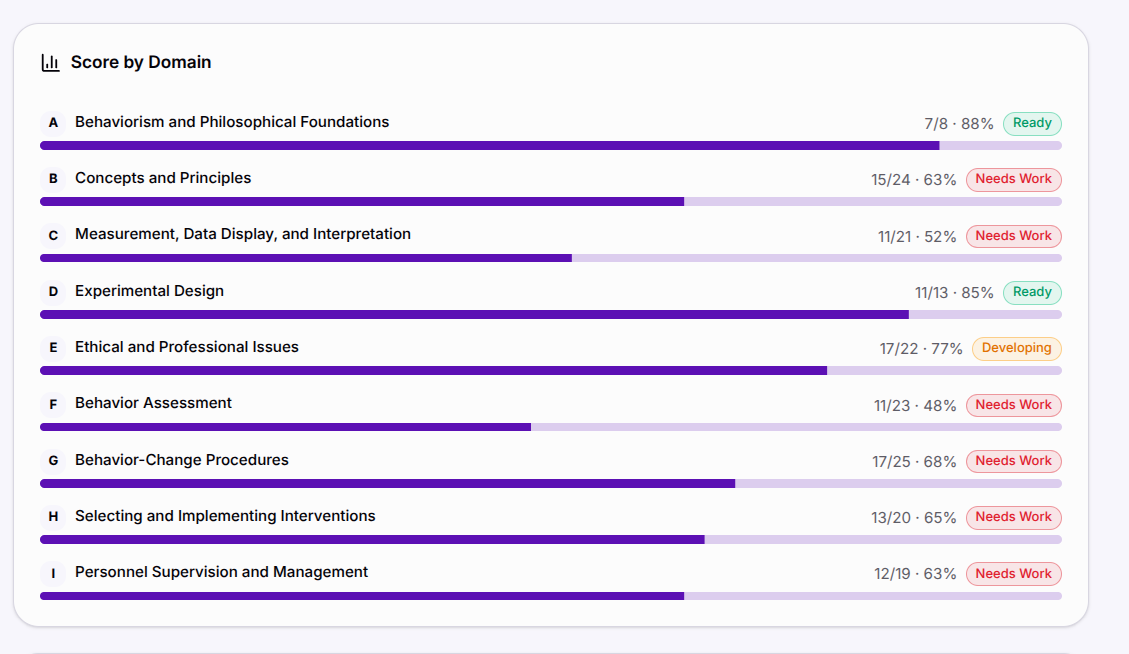
Real report from a BCBA Full Mock · 114/175 correct · 65%
Failed the BCBA exam? This is built for you.
Most BCBA exam retakers don't need another study guide — they need to know why they missed what they missed. BehaviorPREP is exam prep built for retakers: diagnostic score breakdowns, question-dissection practice, and a study plan based on your actual error patterns.
Why do I keep getting stuck between two choices on the BCBA exam?
Two choices can sound reasonable while only one fits the details provided. Identify what the question asks, then compare each choice against the scenario. For behavior-consequence questions, map the antecedent, behavior, and consequence; do not assume a behavioral effect that the question never describes. Review why the tempting choice fails, not just why the correct answer works.
How to read long BCBA scenario questions without running out of time.
Identify the question being asked, then read the scenario for the details needed to answer it. Separate relevant facts from background information and note words such as BEST, FIRST, or NOT. Use a short ABC sketch when the question concerns a contingency, rather than rewriting the whole story. Practice with a timer and review where rereading slowed you down.
What to do when flashcards aren't helping you pass BCBA mock exams.
Keep flashcards for definitions, but add practice applying those definitions to original scenarios. Explain your choice before checking the answer, then explain why each other option does not fit. Use your mock report to distinguish missing knowledge from difficulty applying a concept or telling similar concepts apart. Build your next study session around that specific gap.
Failed the BCBA exam more than once?
A retaker study plan should start from your score breakdown, not from page one of a study guide. BehaviorPREP's diagnostic mock exams produce a domain-by-domain score breakdown that shows exactly what to fix before your next attempt — whether it's your 2nd or your 4th.
Why am I failing BCBA mock exams?
Most retakers don't have a memorization problem — they have an application problem. The BCBA exam tests clinical reasoning, not rote task-list recall. Our reports separate knowledge gaps from application and discrimination errors so you study the right thing.
How do I answer BCBA scenario questions?
Question dissection is a trainable skill: identify the controlling variable, balance the ABC model, and spot the distractors before reading the options. Every BehaviorPREP question includes per-option rationales that model this breakdown — including MO vs SD, Matching Law, and ethics code scenarios.
How is BehaviorPREP different from flashcards and study guides?
If you've used flashcard apps or popular study guides and still miss application questions, the gap isn't effort — it's practice type. BehaviorPREP is built on instructional design: 6th Edition task list application practice, Socratic tutoring, and mock exams that train reasoning, not recall.
I got a 380 on the BCBA exam — what do I do?
The 380–395 range is the heartbreaking 'so close to 400' zone, and it usually means a handful of domains are costing you the pass. Jumping from 380 to passing starts with a retaker score breakdown: re-studying everything after failing wastes months, while targeted question dissection on your weakest domains closes the gap.
Why do I keep picking the distractor answer?
Getting down to two answers and choosing wrong is the most common retaker pattern. Distractors are written to reward partial reasoning — our per-option rationales show you exactly why the tempting answer is wrong, including how to answer BEST or FIRST questions where more than one option looks correct.
Are BCBA mock scores like the actual exam?
Mock scores vs the real test depend on question quality. If your mock (from prep courses or elsewhere) rewards memorized definitions, it overestimates your readiness for scenario questions. BehaviorPREP mocks mirror the application-heavy style of the real exam, so your diagnostic breakdown actually predicts what to fix.
I feel like a terrible clinician after failing — is that normal?
Retaker panic is real, and failing the exam does not mean you're a bad clinician — it means the exam's question style hasn't been trained yet. The best tutoring for multi-attempt retakers rebuilds confidence through small wins: a study group with an application focus, question dissection practice, and a plan built from your own error data.
Certificates that meet BACB and iBAO standards
BehaviorPREP is both a BACB ACE Provider (#OP-19-3171) and an iBAO-approved IBT content provider. Our instructors hold both BCBA and IBA certifications. All certificates include the required provider number, instructor credentials, event title, modality, and completion date — auto-generated the moment you pass.